---"I want to add my praise for WiggleLegs Frog toy. My cat
loves to play with
WiggleLegs.
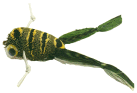 No other toy will do. When I ask her to find
WiggleLegs she goes right to it! I just ordered 3 more as I'm afraid
you will stop making them and then I don't know what we will do!" No other toy will do. When I ask her to find
WiggleLegs she goes right to it! I just ordered 3 more as I'm afraid
you will stop making them and then I don't know what we will do!"
---"Once again, you have provided excellent
service with an excellent product. Thanks for the extra - it was a hit!
My cats are totally addicted to the
WiggleLegs Frog, so please keep plenty in stock!"
 ---"I
just wanted to let you know that my cat, Molly, is absolutely addicted
to your
FlyToys.
I literally have to hide them from her so she will go to sleep at night,
but as soon as morning arrives she is sitting right in front of their
hiding place waiting for them to come out and play." ---"I
just wanted to let you know that my cat, Molly, is absolutely addicted
to your
FlyToys.
I literally have to hide them from her so she will go to sleep at night,
but as soon as morning arrives she is sitting right in front of their
hiding place waiting for them to come out and play."
Each MetPet FlyToy is
handmade by skilled artisans with great attention to detail. They
come in the form of bugs, amphibians, mammals and more in three very
reasonable price points.
---"I can't believe how your
company understands cats so well" |
| |
What To Do About a Stray Cat: Introduction
Since cats wander around outside, what
constitutes an actual stray?
MetPet.com Staff Writer
|
Few of us can pass a stray cat on the street without
wanting to pick it up and find it a home. At the very least,
we want to test it for diseases, have it neutered
and vaccinated and set it on its way (which is usually as far as our
backdoor). to test it for diseases, have it neutered
and vaccinated and set it on its way (which is usually as far as our
backdoor).
Since cats are tremendously
successful breeders, the number of stray cats never seems to decline
even with the best of intentions and efforts. Here are some
basics about stray cats.
- A small percentage, usually around 10% depending on
the area, have infectious diseases like FIV or FELV. These can
be transmitted to healthy, unvaccinated cats and, when vaccinations
fail, to vaccinated cats.
|
|
- Some "strays" are just outdoor cats roaming their territory.
If they are well-groomed and well-fed, they likely have a home. If,
over time, they become thin and unkempt they are likely lost or abandoned. - Some strays are feral cats, domestic
cats reverting to their wild behavior which they do easily in a single
generation without sufficient human contact. Feral cats are difficult to
make into domestic cats and, at best, become backdoor eat-and-runners. |
|
- The easiest stray to take in are pets who are lost or have been abandoned. They are
approachable and, because they have experienced a difficult life
outdoors, can become enormously affectionate pets.
- If you decide to adopt or find a home for a
stray cat, be prepared for a few hundred dollars worth of veterinary
costs plus your time and effort to incorporate the newcomer into
your home or find a new home. This isn't an easy task since
there are so many cats available but it's well worth the effort.
|
|
|
|