---"I want to add my praise for WiggleLegs Frog toy. My cat
loves to play with
WiggleLegs.
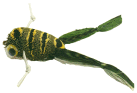 No other toy will do. When I ask her to find
WiggleLegs she goes right to it! I just ordered 3 more as I'm afraid
you will stop making them and then I don't know what we will do!" No other toy will do. When I ask her to find
WiggleLegs she goes right to it! I just ordered 3 more as I'm afraid
you will stop making them and then I don't know what we will do!"
---"Once again, you have provided excellent
service with an excellent product. Thanks for the extra - it was a hit!
My cats are totally addicted to the
WiggleLegs Frog, so please keep plenty in stock!"
 ---"I
just wanted to let you know that my cat, Molly, is absolutely addicted
to your
FlyToys.
I literally have to hide them from her so she will go to sleep at night,
but as soon as morning arrives she is sitting right in front of their
hiding place waiting for them to come out and play." ---"I
just wanted to let you know that my cat, Molly, is absolutely addicted
to your
FlyToys.
I literally have to hide them from her so she will go to sleep at night,
but as soon as morning arrives she is sitting right in front of their
hiding place waiting for them to come out and play."
Each MetPet FlyToy is
handmade by skilled artisans with great attention to detail. They
come in the form of bugs, amphibians, mammals and more in three very
reasonable price points.
---"I can't believe how your
company understands cats so well" |
| |
| |
Irish Wolfhound
|
|
| |
|
| |
|
| |
Giant Breed |
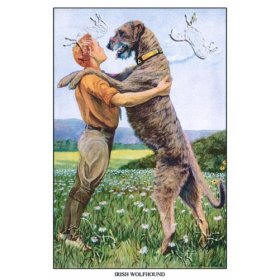
See your dog's photograph or illustration here
 |
| |
Sighthound |
| |
|
| |
Country of Origin
|
Ireland centuries ago |
| |
Ancestry |
The origin of the ancient
Irish Wolfhound is unknown. The modern Irish Wolfhound is a mixture of
Scottish Deerhound, Great Dane, Borzoi, Tibetan Wolfdog and the last of
the ancient breed. |
|
Original Function |
Used in war in ancient times.
Hunted game particularly wolves and Irish elk. |
| |
Height at Shoulder |
Female 30" minimum
Male 32" minimum
The Irish Wolfhound is the tallest breed in the world although an
individual Great Dane currently holds the Guiness title. |
| |
Weight |
Female 105 lbs, Male
120 lbs |
| |
Lifespan |
7 Years |
| |
Coat |
Medium-length rough or wiry
coat: black, white, gray, brindle, red and fawn colors. Bushy
eyebrows and a small beard add to the image of a rough coat.
|
| |
Tail |
Long tail held down. |
| |
Head |
Strong, slightly flat head
with long muzzle |
| |
Ears |
Medium sized ears held down |
| |
Related Breeds |
Great Dane, Tibetan Wolfdog,
Borzoi, Scottish Deerhound |
| |
Alternative Names |
Cu Faoil |
| |
Nicknames |
Gentle Giant |
|
|
|
| |
Grooming: |
Rough, medium-length coat requires biweekly brushing,
semi-annual stripping and occasional scissoring for neatness. |
|
Exercise requirements: |
Moderate, daily exercise in the form of long walks. |
| |
Aggression: |
It is moderately friendly towards strangers and other
dogs. As a sighthound, Irish Wolfhounds can be aggressive towards small
animals. |
| |
Temperament: |
The Irish Wolfhound can be intimidating due to its size
but it is generally mellow, calm and sensitive. As with many giant
breed dogs, the Irish Wolfhound has a relatively low metabolism and
energy level. |
| |
Owner requirement: |
Firm, bold but sensitive. Willing to provide
training and sufficient space for this giant dog. Care must be
taken around small animals. |
| |
Trainability |
Moderate |
| |
Health concerns |
Bloat and
gastric torsion, canine hip dysplasia (CHD), elbow dysplasia,
cardiomyopathy, osteosarcoma, tail injuries, sensitivity to anesthesia. |
| |
Environmental requirements: |
Good tolerance for cold. Low tolerance for heat.
Requires firm and soft bedding as well as plenty of space. |
| |
Feeding requirements: |
Smaller, more frequent meals to prevent bloat and
obesity. Particular emphasis on feeding during its growth phase to
prevent skeletal developmental problems. |
|
AKC: American Kennel Club USA: Hounds
UKC: United Kennel Club USA: Sighthounds and Pariahs
CKC: Canadian
Kennel Club: Group 2 Hounds
FCI: Fédération
Cynologique Internationale: Sighthounds (Group 10/Section 2/Breed 160)
ANKC: Australian National Kennel Council: Group 4 Hounds
KCUK: Kennel Club United Kingdom: Hounds
NZKC: New Zealand Kennel Club: Hounds |
|
|
|
The Irish Wolfhound is an ancient breed. Its ancestors
may have lived in Greece thousands of years ago. Mention of the Irish
Wolfhound is made in Rome as early as the 4th century. In Ireland they
were prized for their size, courage and ability to hunt wolves and elk.
Irish Wolfhounds were prized as gifts to foreign nobility. They appear
in Irish legends and mythology for their skill, valor and courage.
The decline and disappearance of the wolf and elk in
Ireland led to a decline in the numbers of the Irish Wolfhound. The
breed nearly disappeared in the 1800s. In 1869 Captain George Graham
saved the breed by crossing the last remaining Irish Wolfhounds with Great
Danes, Scottish Deerhounds, Borzois and Tibetan Wolfdogs or Tibetan
Mastiffs. The modern Irish Wolfhound was exhibited in the 1870s
to great fanfare.
Today, the Irish Wolfhound can still harken back to its
hunting roots with lure coursing. As with all sighthounds, they can be
excited by cats, rabbits, other furry mammals and even small dogs.
They may give chase and can even kill the 'prey' so care must be taken
around smaller animals. |
Buy Irish Wolfhound Clothing and Accessories for People
Buy Irish Wolfhound Jewelry
Buy Irish Wolfhound Home Accessories
Buy Irish Wolfhound Books and Printed Materials
|
|